Before the Bergisel became famous for its ski jump, it was known primarily as the site of historic battles. In 1809, Tirolean forces under the command of Andreas Hofer fought Napoleon’s troops on four separate occasions. A monument still stands today in memory of the so-called ‘Tirolean uprising’. Excavations have also shown that the Bergisel was a site for burnt offerings as far back as the Neolithic period.
There are, or were, a total of 67 ski jumps in Tirol, most of which were built between the turn of the century and the 1930s. In present-day Innsbruck alone, there were five hills: on the Hungerburg, in Amras, Igls, at the Husslhof (Wiltenberg) and on the Bergisel. Today, ski jumping still takes place actively on 9 hills across Tyrol, with the Toni Seelos Olympic Hill in Seefeld and the Bergisel Hill in Innsbruck being the best known.
As early as January 1927, the first ski jumping event took place at the Bergisel in front of 5,000 spectators; at that time, it was still held on a natural hill. The hill record stood at 47 metres. Just one year later, an inrun tower was erected to enable jumps of up to 70 metres. Work on the hill continued, with the hill record eventually reaching 75 metres and the spectator numbers rising to 20,000. However, this positive development came to an abrupt end in 1941 when the inrun tower collapsed during a visit by two youth football teams. The Bergisel ski jump had to be demolished and was not rebuilt until 1949, after the end of the Second World War.
The venue has already hosted Olympic events on three occasions: at the Winter Olympics in 1964 and 1976, and at the Youth Olympic Games in 2012. All these events were opened at the Bergisel Stadium.
An Olympic Games opening ceremony without the Olympic flame? Unthinkable! And because Innsbruck hosted the Games no fewer than three times, there are just as many fire bowls on the Bergisel. Incidentally, in 1964 the flame was reignited for the first time in Olympia, Greece, using a concave mirror, and brought to Innsbruck. It last burned in 2026 to mark the 50th anniversary of the XII Winter Games.
The Bergisel ski jump has been a venue for the Four Hills Tournament from the very beginning. This was agreed during a night-time ski jumping event at the Seegrube in Innsbruck in 1952. Since 1953, the event has also been held at the Bergisel – the competition has only had to be cancelled twice. In 2008 and 2022, the famous Innsbruck Föhn was too strong to guarantee the athletes’ safety.
As the ski jump was being modernised for the IXth Olympic Games in 1964 and the work continued even during the winter, the 1961 Four Hills Tournament at Bergisel was held, without further ado, on the building site. A unique occurrence in the history of the competition! Only in 2002 did something similar happen, when the ski jumping took place on the new Bergisel ski jump, which had not yet been officially opened.
In addition to the Olympic Games, three Nordic World Championships were held at the Bergisel – jointly with Seefeld – in 1933, 1985 and 2019. Numerous Ski Jumping Continental Cups and Ski Jumping Grand Prix events have also been held at Bergisel, as has the Air & Style, which took place here a total of twelve times between 1994 and 2015. Incidentally, in 2026 the latter was revived under the name Airdrenaline.
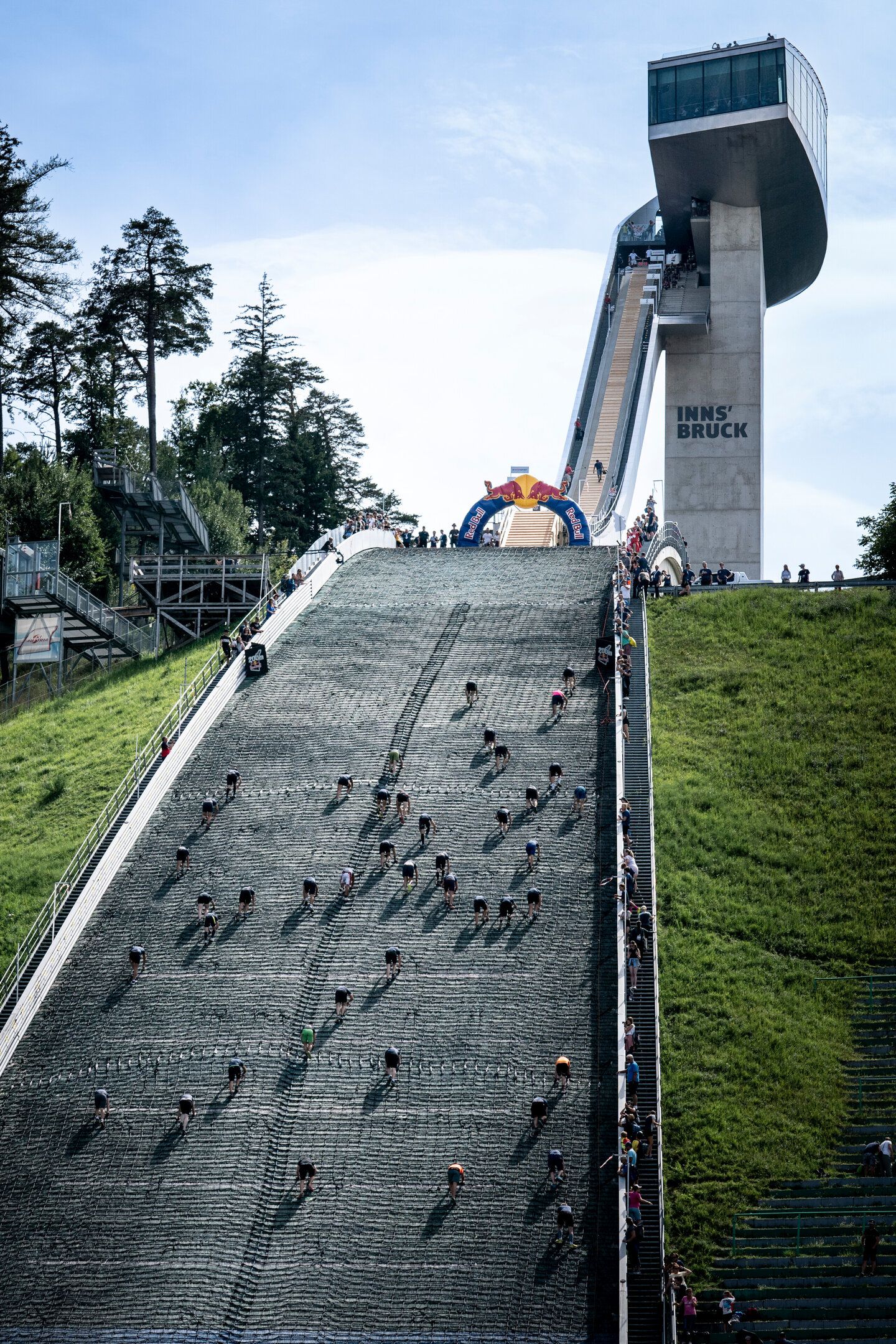
The Bergisel is as versatile as a chameleon when it comes to the use of the ski jump. In 2004, a tennis arena was built at the bottom of the ski jump, where the Fed Cup was held. In the summer of 2008, as part of the European Football Championship, the ski jump venue was quickly transformed into a public viewing arena. And in 2022 and 2025, it hosted the ‘Red Bull 400’ event, where thousands of participants pushed themselves to their limits on the world’s toughest 400 metres, scaling the legendary ski jump from the bottom to the top.
The Bergisel has hosted numerous celebrities – such as Miles Davis, Udo Lindenberg, Steve Coleman, Paco de Lucis and John McLaughlin during the 1987 ‘Utopia Festival’, or H-Blockx, Clawfinger, Massive Attack, Ugly Kid Joe and Cypress Hill as part of the Air&Style, to name but a few. In 1988, Pope John Paul II also celebrated Mass at the Bergisel Stadium with a large congregation – estimates suggest there were between 38,000 and 60,000 attendees.
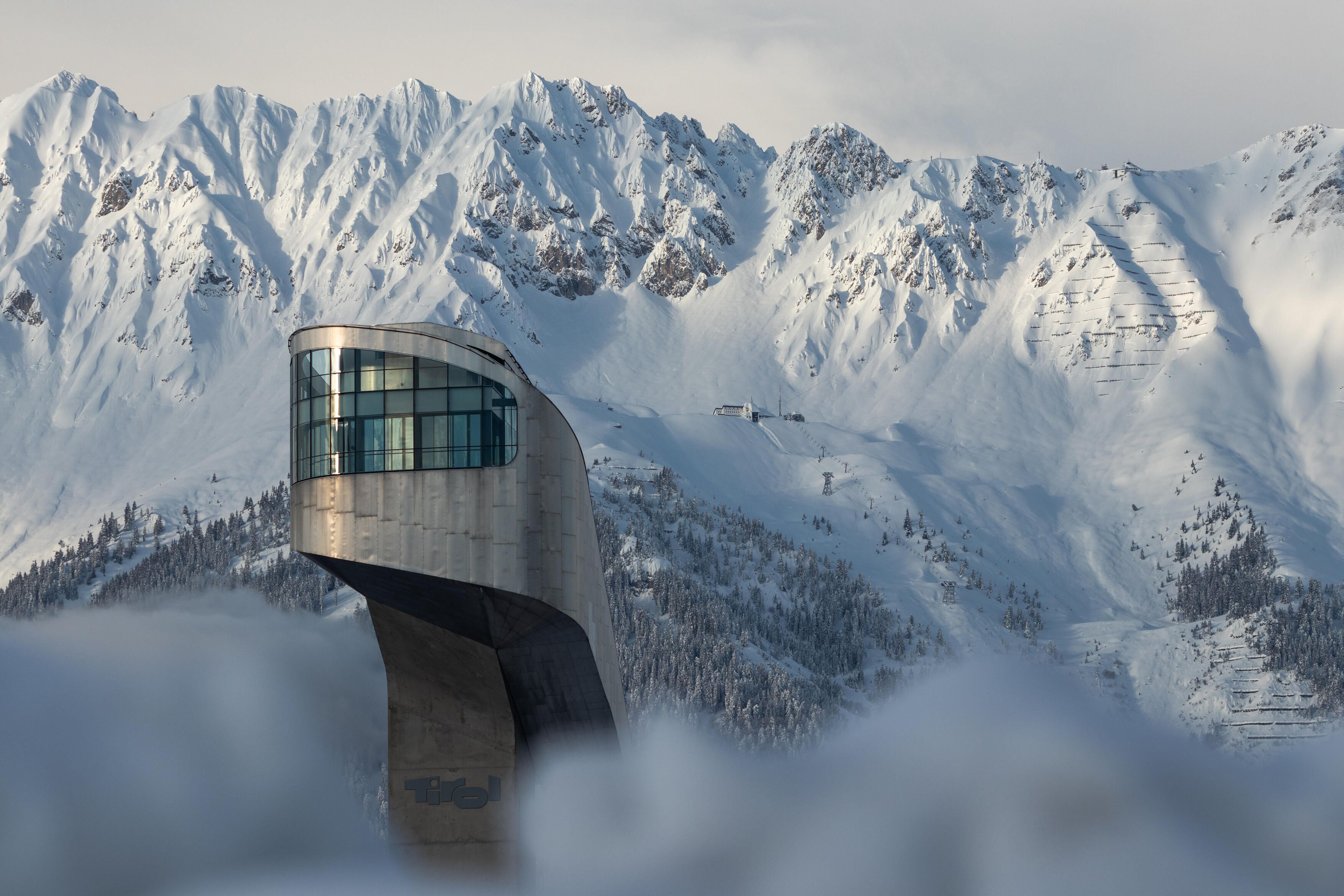
In 1999, the International Ski Federation announced that it would no longer recognise the Bergisel ski jump – which had by then become rather outdated – as suitable for jumping. Later that same year, the City of Innsbruck launched an international competition for the construction of a new ski jump. The contract was awarded to Zaha Hadid.
The Iraqi-British architect Zaha Hadid, who died in 2016, was best known for her precise, futuristic sketches and the curving lines of her buildings. In 2004, she became the first woman to receive the most prestigious honour in architecture, the Pritzker Architecture Prize. According to Zaha Hadid, the challenge of the Bergisel ski jump lay in integrating an element that was originally foreign to the site (a café and viewing terrace) into a predefined structure (the ski jump). And – a slight spoiler – the effort paid off: in 2002, the ski jump was awarded the Austrian State Prize for Architecture.
Before the actual construction work could begin, the disused Bergisel ski jump had to be demolished. In March 2001, the old ski jump tower was spectacularly demolished – a task that proved to be far from straightforward due to the nearby Brenner motorway and the railway lines.
No sooner had the ‘old’ ski jump been dismantled than work could begin on the new jumping facility. The plan was for the Four Hills Tournament to be held at the new facility to mark the event’s 50th anniversary. Work continued day and night to make this goal – which now seems almost utopian – a reality. Ten months after construction began, the tournament was indeed able to take place.
The German Sven Hannawald claimed victory in his debut, and went on to become the first ski jumper in history to win all four jumps in the Four Hills Tournament. The Black Forest native triumphed with jumps of 134.5 and 128 metres. His comments on the jump: “It’s just a wonderful feeling. It’s pure enjoyment.”
The winter ski jumping hill record is held by the Austrian ski jumper Michael Hayböck (2015) with a jump of 138 metres. In summer, the challenge is to beat Adam Malysz’s mark (2004) of 136 metres. The women’s hill record is held by Sara Takanashi, also with a jump of 136 metres.
Wolfgang Loitzl secured Austria’s first home victory only seven years after the first ski jumping event at the new Bergisel. This finally broke the spell, and in the four years that followed, three more ÖSV ‘Eagles’ – Gregor Schlierenzauer, Thomas Morgenstern and Andreas Kofler – triumphed in Innsbruck.
Every year, up to 22,500 fans travel to the Bergisel for the World Tour event, transforming the stadium into a veritable ‘Hexenkessel’ and creating an atmosphere that is unique in the Ski Jumping World Cup.
Women competed in the 2026/2027 Four Hills Tournament for the first time. To enable jumping to take place even after dark, seven floodlight masts had to be installed in the autumn of 2026.
You can get a sense of what the Third Battle of Bergisel was like from the giant circular painting at the Tirol Panorama and Kaiserjäger Museum. As well as other exhibitions, there is also a circular walk there that takes you round the Bergisel ramparts, offering the occasional panoramic view along the way.
A fun fact: the giant circular painting used to be located in the rotunda by the old Hungerburgbahn, which dates back to 1906. After around a hundred years, a new Hungerburgbahn was built further west – designed by none other than Zaha Hadid.
There are 455 steps leading from the stadium entrance to the top of the ski jump. However, you can also make the journey using the inclined lift and the tower lift. It only takes 2 minutes.
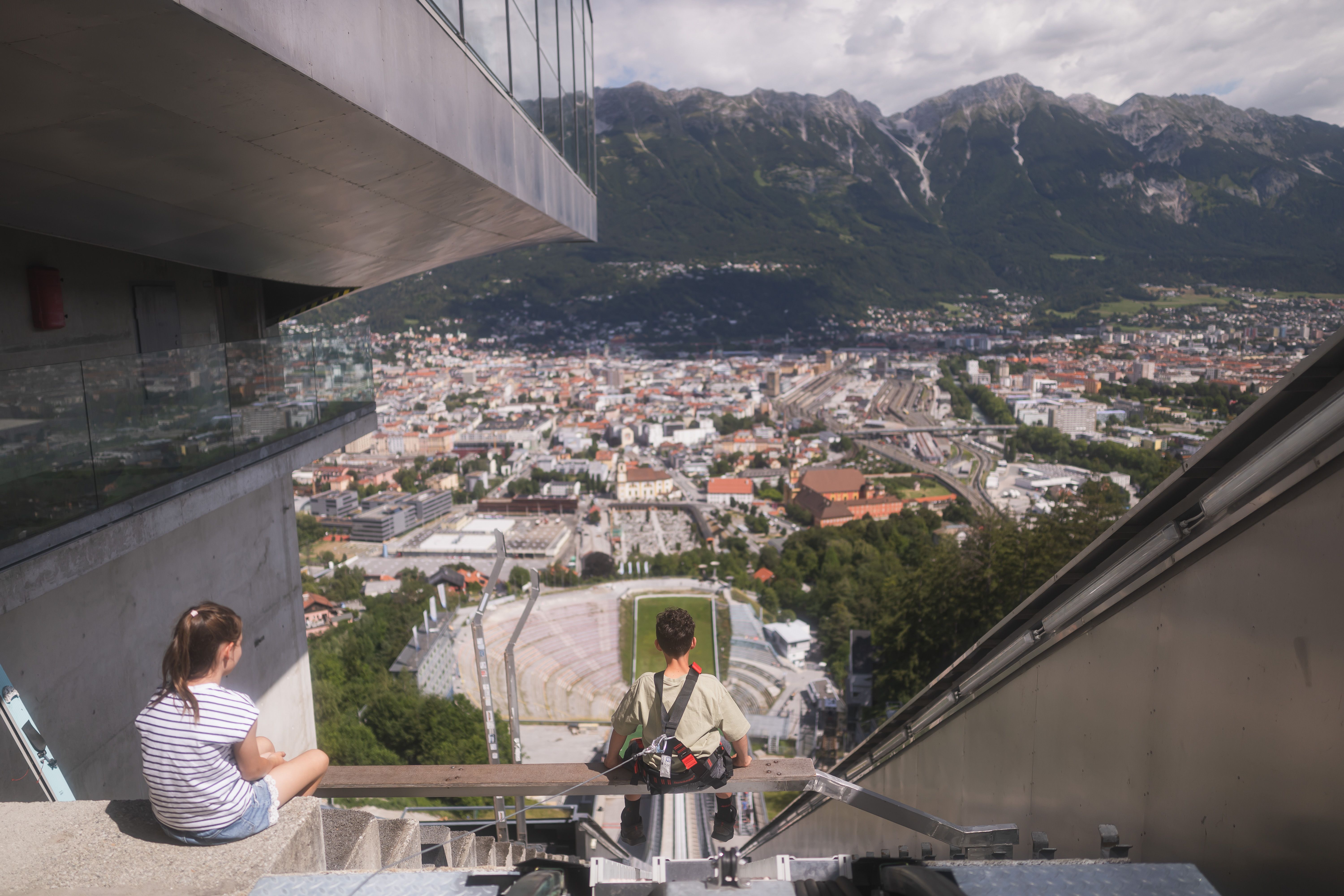
The idea of standing right at the top of the Schanzenturm might be less of a treat for non-ski jumpers – after all, the take-off bar isn’t called the ‘shaky bar’ for nothing. But anyone who’s brave enough can even have a quick sit on it here in summer. Those who’d rather just take it easy can sit in the ‘Bergisel Sky’ panoramic restaurant and enjoy the view from there. Even higher up on the 50-metre-high tower, a viewing platform also offers a 360° panoramic view of the city and the surrounding mountain scenery.